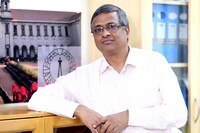
G Jagadeesh
IISc, Bengaluru. FASc since 2022
Gopalan Jagadeesh is the Chair and Professor in the Department of Aerospace Engineering at Indian Institute of Science, Bengaluru. He is also the Founder Chairman of the Centre of Excellence in Hypersonics at IISc and mentors several startups focused on transdisciplinary applications of shock waves.<br/> His research interests include hypersonic aerothermodynamics and shock-wave propagation in complex fluids. He has published extensively in these areas and holds several patents related to innovations involving shock waves and their applications. Prof. Jagadeesh is a Fellow of the Royal Aeronautical Society, the Indian National Science Academy, the National Academy of Sciences, India and the Indian National Academy of Engineering. In addition to his academic contributions, he actively works with voluntary organizations to promote science education among high-school and college students, particularly in rural India.
Session 1C: Inaugural Lectures by Fellows/Associates
Chairperson: V Prakash, Formerly CSIR and CFTRI, Mysuru
Shocking Waves – Healing Touch!
The phenomenon of “shock waves” has historically been associated with aerospace engineering, particularly with supersonic flight. Shock waves occur in nature when different elements within a fluid approach one another at velocities higher than the local speed of sound. These waves are also generated when massive energy is dissipated over an ultra-short duration, as in explosive events. Many methodologies and facilities for generating shock waves of requisite strength have been designed and indigenously developed at the Laboratory for Hypersonic and Shockwave Research (LHSR), Indian Institute of Science, Bengaluru. Over the years, these facilities have enabled several interdisciplinary research programmes at IISc, involving faculty members from physics, chemistry, biology, and materials engineering.<br/> Some of the novel techniques that will be discussed in this talk include retractable aerospikes, smart coatings, forward-facing jets, and concentrated energy deposition for reducing the aerodynamic drag around vehicles flying at hypersonic speeds. Concurrently, by utilizing the remarkable ability of shock waves to instantaneously enhance pressure and temperature in the propagating medium, several innovative shock-wave-assisted techniques have been developed at LHSR. These include non-invasive needleless vaccine delivery, cell transformation, wound healing, biofilm destruction, metal surface modification, and preservative impregnation in bamboo. A broad overview of the recent transdisciplinary shock-wave research and technology development activities at LHSR will be presented in this talk.