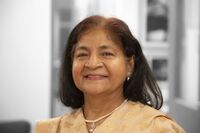
Seema Alavi
Ashoka University, Sonipat
Seema Alavi is a historian who specializes in early modern and modern South Asia, with an interest in the transformation of the region’s legacy from Indo-Persian to one heavily affected by British colonial rule. She started her teaching career at the Jawaharlal Nehru University, New Delhi, and has been a Professor at the Jamia Millia Islamia, New Delhi, and at the University of Delhi, New Delhi, before moving to the Ashoka University, Sonipat, in 2022. Alavi earned her PhD from the University of Cambridge, England. She has twice been a Fulbright Scholar, a Smuts Visiting Fellow at the University of Cambridge, and a visiting scholar at the Harvard- Yenching Institute, Cambridge. In 2010, she was at the Harvard Radcliffe Institute, Cambridge, as a William Bentinck-Smith Fellow.
Session 1E: Public Lecture
Chairperson: Raghavan Varadarajan, IISc, Bengaluru (President, IASc)
Entangled Histories: Unani Medicine, Religion and Politics in British India
The talk puts the spotlight on the entangled histories of medicine, religion, and politics in the long 19th century – the period of British rule in India. It analyses the engagement between Unani – a Greco Arab system of family-controlled medical knowledge – and English doctors. She argues that Unani flourished as an aristocratic medical tradition in the Mughal Empire. And during the period of imperial decline (18th century), it shifted its focus from health as an aristocratic virtue to an emphasis on medical wisdom and science. This facilitated its intellectual dialogue with English doctors during India’s colonial encounter. Colonial rule triggered fresh changes in the Unani healing as it tried to accommodate itself with English medical thinking. Individuals outside the established families of healers reached out to Sufi and Prophet healing practices. They used the freshly arrived print and access to the vernaculars to incorporate them into their medical writings. The old literate elite families viewed this religious outreach as a grave threat to Unani. They responded by setting up institutions of learning to professionalize and modernize Unani knowledge by restoring its Greco-Arab text-based core. These institutions helped them maintain full control over medical knowledge. The talk focuses on these developments to show how ideas of ‘medical modernity’ and professionalization are not necessarily singular and Eurocentric but context-based. The ‘modern’ Unani, bereft of religious practice, found an easy entry into the medical projects of contemporary India’s health ministry.