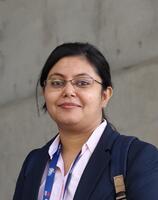
Oishee Mazumder
TCS Research, Kolkata
Dr Oishee Mazumder received her B.Tech. degree in Electronics and Instrumentation from the West Bengal University of Technology in 2010, graduating with first rank (Gold Medal). She completed her M.Tech. and PhD in Mechatronics and Robotics from Indian Institute of Engineering Science and Technology (IIEST), Shibpur, receiving her PhD in 2017. Her doctoral work focused on assistive systems, including exoskeletons and ankle–foot prostheses, and was carried out as part of a collaborative project supported by the Department of Science & Technology (DST), New Delhi. This work was showcased at Rashtrapati Bhavan in 2016. She joined TCS Research in 2017 and currently serves as a Senior Scientist at TCS Research, Kolkata. Her research interests include biomechanical modelling, computational modelling of biophysicalsystems, and the development of digital twins for healthcare applications. She has authored around 50 research publications, holds 35 patents, and was a top-four finalist for the DST Young Scientist Award (Women in Science and Engineering) in 2020. She is also a recipient of the TCS Young Scientist Award (2023).
Session 2A: Symposium on Artificial Intelligence in Health
Chairperson: Somdatta Sinha, IISER Kolkata, Nadia and Narendra Dixit, IISc, Bengaluru
From AI to Actionable Physiology: Digital Twins for Precision and Personalized Healthcare
Healthcare is undergoing a shift toward precision and personalized care, driven by the growing availability of large-scale biomedical data and advances in artificial intelligence. However, while AI- driven approaches excel at identifying patterns, they often remain disconnected from the physiological mechanisms required for patient-specific decision-making. Digital bio twins are emerging as a promising framework to bridge this gap, integrating data-driven models with physiological representations to create dynamic, individualized models of human function. These models enable not only prediction, but also simulation of system behavior under “what-if” scenarios, allowing potential interventions to be explored in silico prior to application. Within this evolving landscape, initiatives such as those at the TCS are advancing a portfolio of digital bio twins across organs and physiological systems, contributing toward the vision of interconnected, patient-specific virtual representations of the human body. In this talk, the broader spectrum and potential of digital twins in healthcare are outlined, with cardiac digital twins presented as a representative example of how non-invasive data can be translated into functional insight and support predictive assessment. Emerging directions further extend this paradigm to performance and wellness contexts, where coupled representations of cardiac, pulmonary, and musculoskeletal systems enable a more holistic view of human function under stress, adaptation, and recovery. Together, these developments point toward a shift in healthcare; from interpreting data to understanding physiology, and from prediction to informed intervention. This transition enables more personalized, physiology-driven decision-making grounded in actionable insight